Autonomous driving vehicles consist of an autonomous driving kit (ADK), which serves as the vehicle’s eyes and brain, and an autonomous driving chassis, which serves as the vehicle body.
Isuzu Expertise Applied to the ADK
While ADK development is based on sensor and AI technologies, Isuzu’s expertise as a commercial vehicle manufacturer is also indispensable when determining sensor placement and the decision-making criteria used by AI.
By combining the expertise of its start-up partners with Isuzu’s own knowledge, the Company is advancing ADK development that leverages its unique strengths as a commercial vehicle manufacturer.
AD Chassis
Development of the autonomous driving chassis is based on vehicle technologies honed over many years and is an area where Isuzu’s expertise is directly applied. One key difference between said chassis and a conventional chassis is the need for redundancy.
To enable the vehicle to come to a safe stop without human intervention in the event of a system abnormality, Isuzu has established a dual-redundant platform with duplicated steering and braking systems, as well as duplicated power supply systems. Furthermore, Isuzu recognizes the potential significant value in being a commercial vehicle manufacturer that develops autonomous driving technologies that achieve both mass-production quality and stable, reliable vehicle operation after autonomous driving is adopted by wider society. Accordingly, the Company continues to advance its initiatives in this field.
What Autonomous Driving Requires for Commercial Vehicles
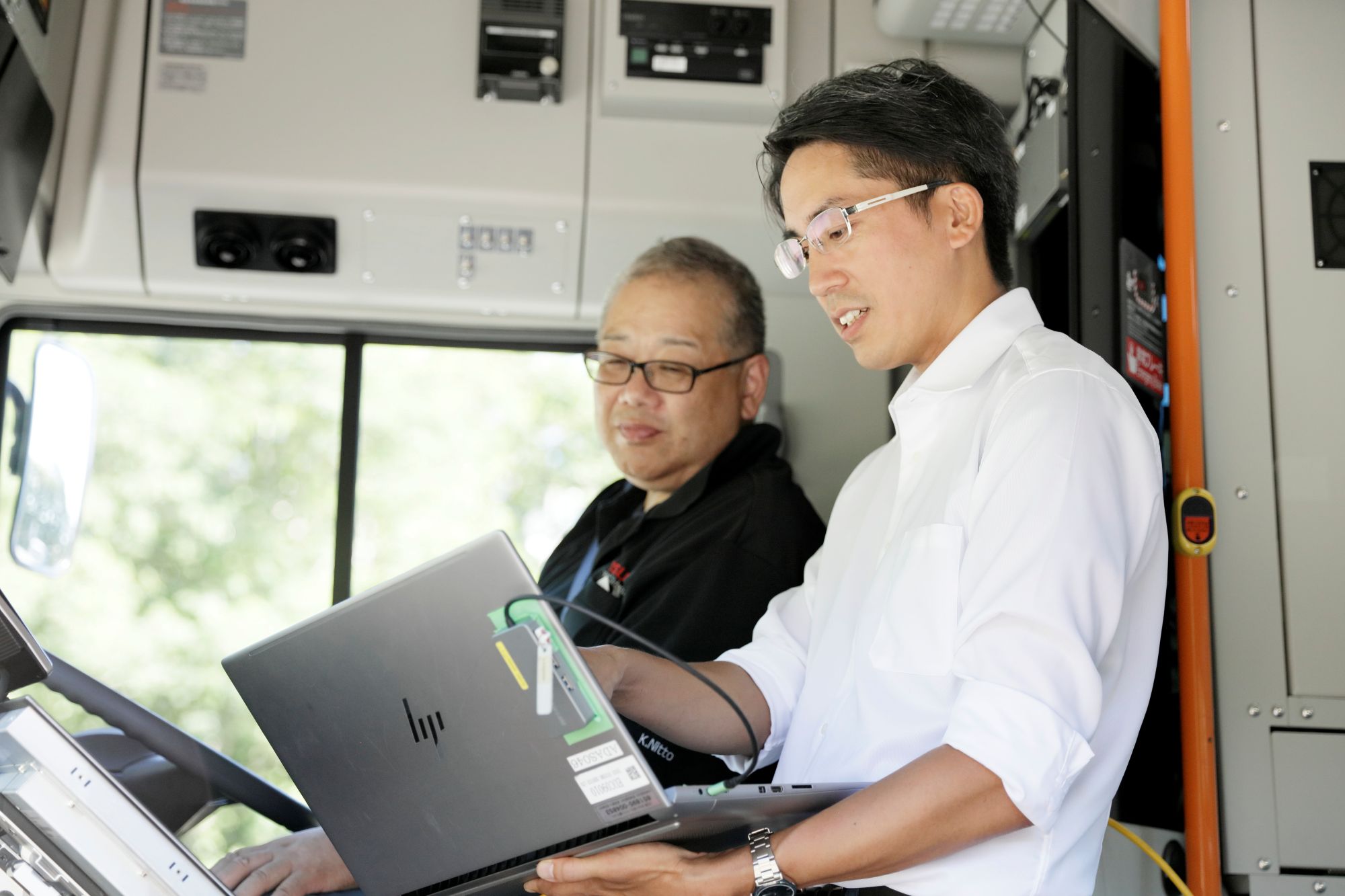
Like passenger vehicles, commercial vehicles require the ability to perceive complex traffic environments and predict sudden pedestrian movements. In addition, however, their vehicle control must account for their much greater mass and inertia.
For example, a heavy-duty truck weighing 25 tons cannot stop immediately when the ADK issues a stop command. Compared with a passenger vehicle, there is a significant delay before the vehicle responds and braking begins to take effect. Vehicle control must account for this delay.
Simply stopping is not enough. Commercial vehicles carry customers’ valuable cargo, so sudden braking must be avoided to prevent load shifts and cargo damage. The same applies to autonomous route buses, where even relatively abrupt braking can increase the risk of passengers falling.
Safely stopping a vehicle that is physically difficult to stop requires predicting conditions hundreds of meters ahead and controlling braking with extreme precision.
In addition, both vehicle weight and center of gravity change depending on the load, meaning the same truck can behave like a very different vehicle under different conditions. An empty truck and a fully loaded truck behave very differently.
The ADK must therefore continuously calculate the vehicle’s current state in real time while driving. The kind of vehicle control that human drivers develop through experience is essential to achieving safe autonomous driving for commercial vehicles.