Technologies Required for Level 4 Autonomous Driving
Level 4 autonomous driving enables unmanned operation in which the autonomous driving system performs the driving task. The system required to achieve this consists broadly of four elements: the ADK (Autonomous Driving Kit), ADK development toolchain, data and equipment, the AD chassis (Autonomous Driving Chassis), and the systems for monitoring operation
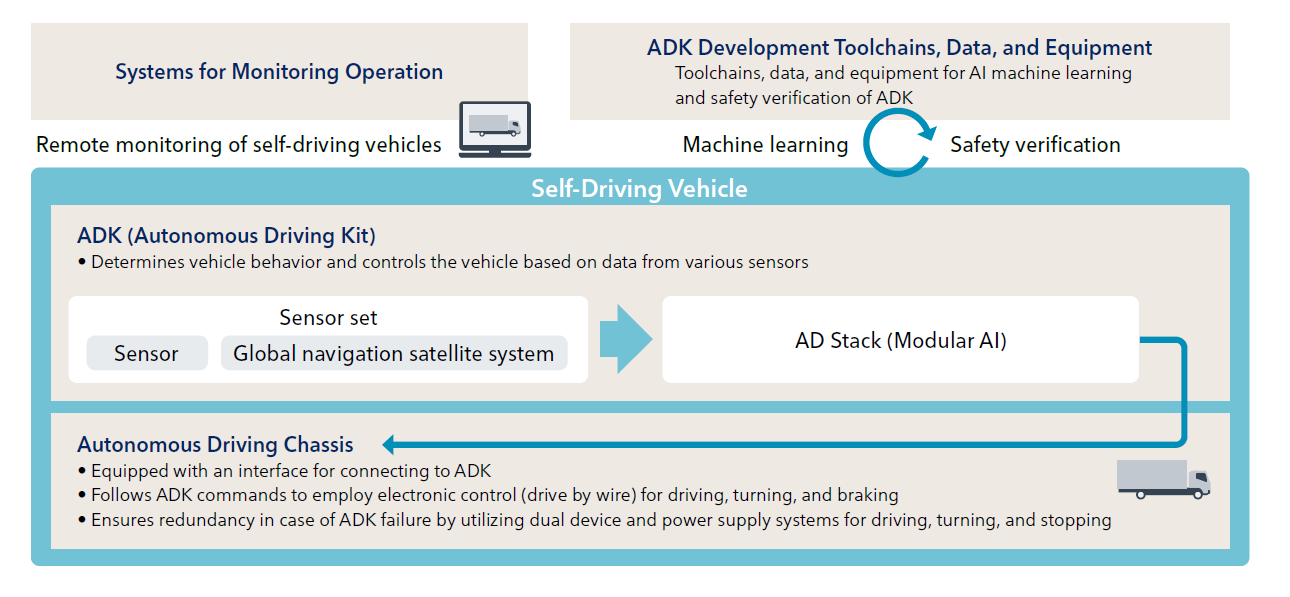
The ADK serves as the “brain” of the autonomous vehicle, determining vehicle behavior and controlling the vehicle based on information from various sensors. A sensor suite consisting of cameras, radar, LiDAR, GNSS (Global Navigation Satellite System) and other sensors captures information about the surrounding environment and vehicle position. Based on this information, the AD stack—the core software architecture for autonomous driving—performs the sequence of perception, prediction, planning and control.
The AD chassis (Autonomous Driving Chassis) translates instructions from the ADK into actual vehicle movement. Equipped with an interface connecting the ADK and the vehicle, it electronically controls driving functions such as accelerating, steering and braking through by-wire systems in accordance with ADK instructions. To enhance safety in the event of a system failure, steering and braking systems as well as power supplies are duplicated to provide redundancy.
We develop the system through repeated cycles of AI machine learning and safety verification, using simulation environments, data and testing facilities to validate ADK safety.
The remote monitoring system monitors autonomous vehicle operation and system status. If an abnormality or accident occurs, it alerts the designated supervisor responsible for specified automated operations.

Autonomous Driving Software Architecture (AD Stack)
There are three main AD stack architectures for autonomous driving, depending on how functions such as perception, prediction, planning and control are combined.
In a rule-based architecture, AI is used for perception, while subsequent prediction, planning and control are handled according to predefined rules. Because the role of each function and the decision-making process are clear, the system is highly interpretable and its safety is easier to explain and verify. However, as driving environments and conditions increase, the number of required rules grows substantially, increasing the development burden when scaling the system.
Modular AI maintains a modular structure for functions such as perception, prediction/planning and control, while applying AI to each module. It retains a degree of the interpretability and ease of safety verification offered by rule-based systems while improving the ability to handle complex situations through AI, making it easier to balance safety and scalability. Compared with an End-to-End (E2E) architecture, however, it requires interface consistency among AI modules as well as development and tuning for each module.
An E2E (End-to-End) architecture uses integrated AI to process everything from sensor input to vehicle-control output. It can learn complex driving behavior directly from data, offers high scalability and can continuously improve through data-driven learning. On the other hand, AI decisions are less interpretable, which may make it difficult to provide sufficient explanations when applying the technology to Level 4 or higher autonomous driving, where the automated driving system performs the driving task.