What Is the EVision Cycle Concept?
The EVision Cycle Concept is a battery-swapping solution proposed by the Isuzu Group as a new option for pursuing carbon neutrality. By separating the battery from the chassis and enabling the two to be managed and operated independently, the solution is expected to help resolve a variety of social issues. Based on this concept, we are driving forward the development of vehicles and battery stations for demonstration testing.
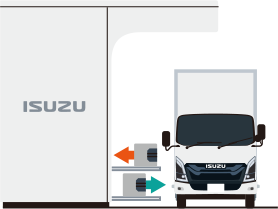
- 拡大
- Illustration of Battery-Swapping
Wider adoption of battery electric vehicles (BEVs) requires overcoming challenges such as reducing charging time and vehicle prices and promoting battery reuse. The EVision Cycle Concept separates the battery from the vehicle and uses a swapping system, helping to reduce vehicle cost and avoid concentrated charging demand at facilities. As the EVision Cycle Concept solution to these challenges, Isuzu proposes two elements: stations that enable smooth battery swapping and battery-swappable EVs designed to use them.
Demonstrations of the Battery-Swapping Solution
Here are some of the major demonstration projects currently underway.
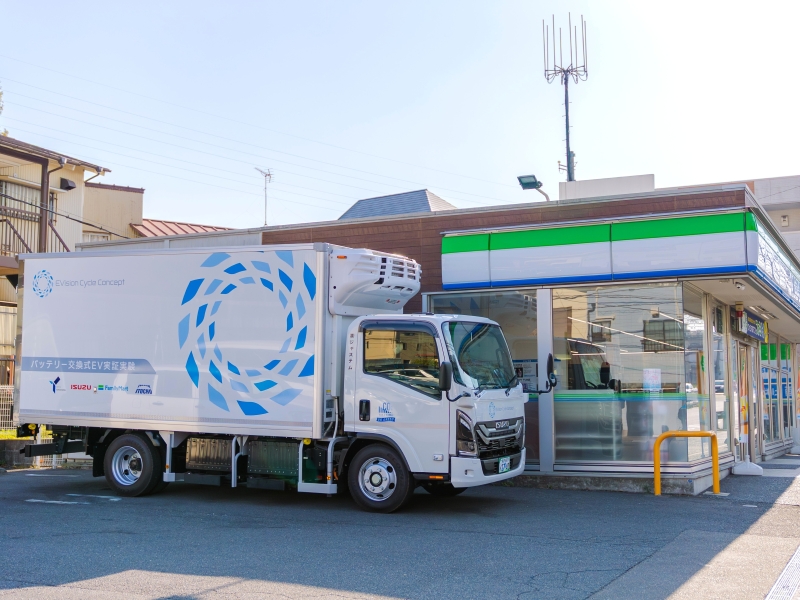
In November 2025, Isuzu, FamilyMart Co., Ltd., ITOCHU Corporation and the City of Yokohama began a demonstration in Yokohama using battery-swappable ELF EVs to deliver products to approximately 80 FamilyMart stores.
Deliveries to 24-hour convenience stores continue throughout the day and night, requiring high vehicle utilization. At the same time, charging downtime is a major challenge when electrifying delivery trucks.
Battery-swapping vehicles, which can replace a depleted battery with a fully charged one in a short time, are therefore considered an effective solution.
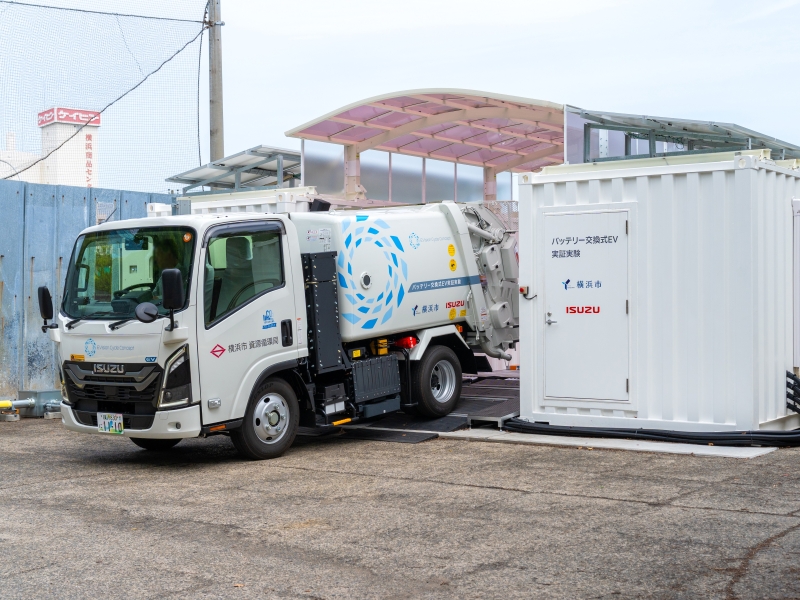
Isuzu and the City of Yokohama began a demonstration of a battery-swappable EV refuse collection vehicle in Yokohama in June. The project is verifying the practicality and stable operation of battery-swapping EVs in an environment where the traction battery used for driving also supplies power to the body equipment that compacts collected waste.
Refuse collection vehicles operate in designated areas and on set routes at specified times, making daily driving distances relatively easy to plan. Because waste collection also involves frequent stopping and starting on residential streets and local roads, often in the early morning, low-noise battery EVs (BEVs) are expected to be well suited to this application. On the other hand, electrifying refuse collection vehicles requires electricity not only for driving but also for operating the body equipment, increasing overall power consumption.
To maintain stable collection operations while traveling through collection routes, battery-swapping vehicles that can replenish energy in a short time are considered one effective option.