- Sustainability TOP
- Governance
- Corporate Governance
Corporate Governance
Basic Approach
In order for Isuzu to continuously increase revenues and enhance corporate value through its corporate activities, the Company believes that it is essential to establish a corporate governance system that provides a framework for regulating such activities.
Furthermore, we believe that the fundamental purpose of corporate governance is to respect the perspectives of, and build constructive relationships with, all of our stakeholders, and to that end we endeavor to ensure fairness and transparency in our corporate affairs through timely and appropriate disclosure of important information. In particular, we believe that a key element of corporate governance is to develop an internal structure and environment that protects the rights and interests of all stakeholders and ensures equality among stakeholders.
Management Structure
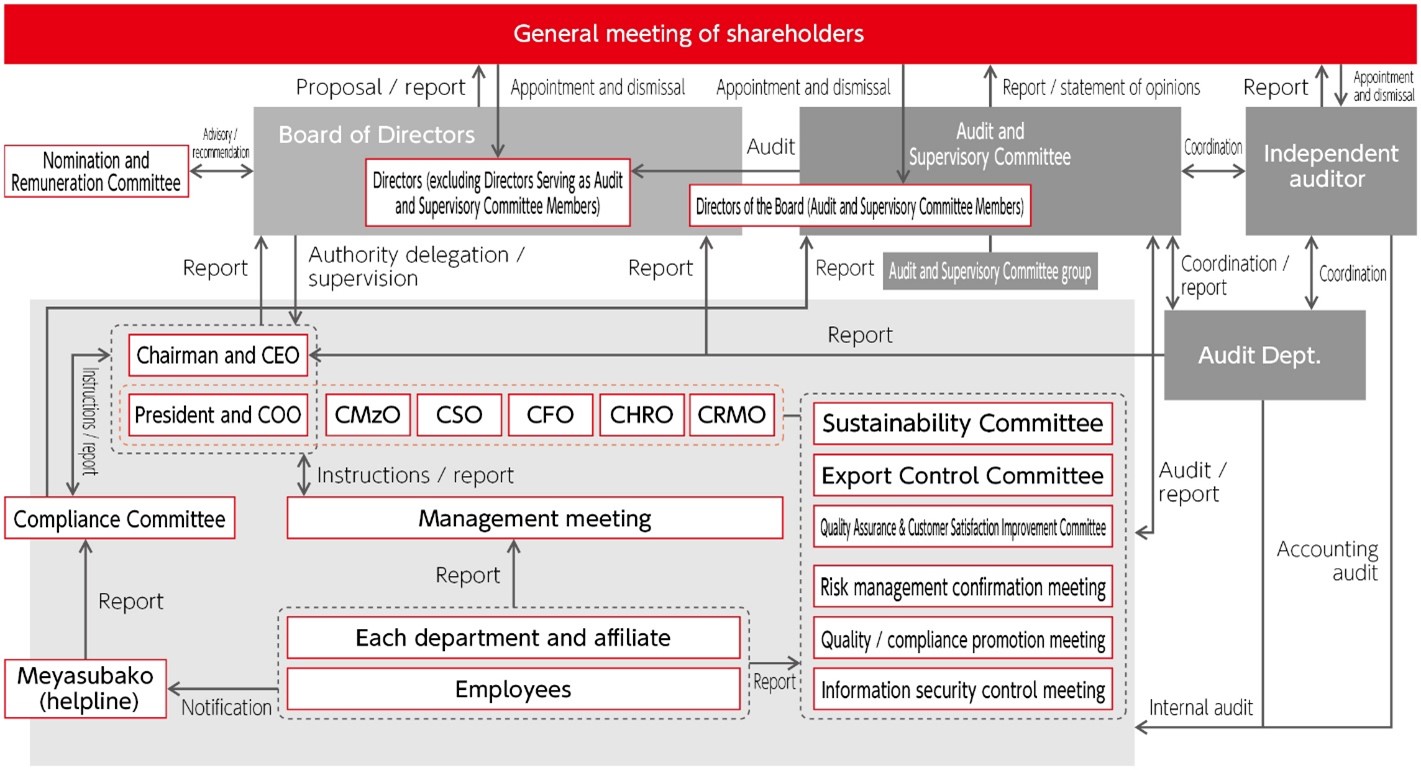
Isuzu is a company with an Audit and Supervisory Committee, and we have established a Board of Directors and an Audit and Supervisory Committee as statutory meeting structures to resolve, supervise, and audit the execution of major business activities. In addition to these statutory meeting structures, we have established a Management Meeting to deliberate on important policies and plans, conduct business management, and oversee other overall business activities. We also have various advisory bodies and meeting structures to facilitate supervision and decision-making on business execution.
The outline of our corporate governance structure is as follows (as of June 25, 2026).
Board of Directors
The Board of Directors lives up to the mandates and confidence of shareholders and, for the purpose of consistently enhancing our corporate value, makes important decisions and conducts supervision on issues that concern our business management. In principle, the Board of Directors holds regular monthly meetings and may convene extraordinary meetings as needed to deliberate and make decisions on necessary matters. Currently, the Board of Directors consists of 14 directors (11 men, 3 women). The Chairman is Masanori Katayama, who serves as the Chairman and Director of the Board. Of the 14 directors, 6 are Independent Outside Directors.
Audit and Supervisory Committee
The Audit and Supervisory Committee follows the audit plan that it established, and audits and supervises the Board of Directors' decision making and directors' execution of business.
The current Audit and Supervisory Committee is composed of five members (3 men, 2 women). To strengthen the auditing and supervisory functions of the Audit and Supervisory Committee Members and to enable them to collect information daily, share information at important internal meetings, and fully cooperate with the accounting auditors and the internal audit division, two members have been selected as Standing Audit and Supervisory Committee Member. The Chairman of the Committee is Hirotomo Abe, an outside director who are Audit and Supervisory Committee Member. Of the five directors who are Audit and Supervisory Committee Members, three are independent outside directors.
All five directors who are Audit and Supervisory Committee Members are designated Audit and Supervisory Committee Members.
Nomination and Remuneration Committee
In addition to the statutory organizations mentioned above, Isuzu has established a voluntary Nomination and Remuneration Committee, an arbitrary organization on corporate governance that is designed to enhance the independence, transparency, and objectivity of the Board of Directors' functions related to nominating officer candidates, selecting executive management, and determining officer remuneration. The committee is chaired by an outside director.
Isuzu's Nomination and Remuneration Committee consists of five members (4 men, 1 women), including two Inside Directors and three Outside Directors. The Chairman of the Committee is Mitsuyoshi Shibata, an Outside Director, who deliberates on and provides recommendations on the matters referred by the Board of Directors.
Executive Officer System and Management Meeting
By separating supervision and business execution, Isuzu is building a rapid decision-making and execution system through improvements in the deliberations in the Board of Directors, the supervisory organization, and the proper transfer of power from the Board of Directors. We also have executive officers and executives to take responsibility for a rapid decision-making and execution structure and for business execution in the areas of their assignment.
The Company has established a Management Meeting consisting of 13 members in total, all of whom are men, including the respective CxOs, who are the chief officers responsible for their respective areas, the EVPs of each division and others. The CEO serves as chair of the Management Meeting, which deliberates on and makes decisions regarding matters related to management and business execution within the scope of authority delegated by the Board of Directors.
CxO System
To enhance corporate value across the entire Group, Isuzu has established the following CxO (Chief Officer for each field) positions with the goals of improving expertise in response to increasingly complex issues, accelerating management speed, and strengthening governance.
- CEO (Chief Executive Officer)
- CSO(Chief Strategy Officer)
- CFO(Chief Financial Officer)
- CTO(Chief Technology Officer)
- CLO(Chief Logistics Officer)
- CDXO(Chief Digital Transformation Officer)
- CHRO(Chief Human Resource Officer)
- CRMO(Chief Risk Management Officer)
Initiatives
Governance - related Initiatives Themes
As corporate governance has been strengthened in Japan in recent years, Isuzu has endeavored to reform its governance. We will remain committed to strengthening our governance and enhancing our corporate value.
| Term | 115th | 116th | 117th | 118th | 119th | 120th | 121th | 122th | 123th | 124th | 125th |
|---|---|---|---|---|---|---|---|---|---|---|---|
| Year Ended | March 2017 | March 2018 | March 2019 | March 2020 | March 2021 | March 2022 | March 2023 | March 2024 | March 2025 | March 2026 | March 2027 |
| Outside Directors (Women) |
2 (0) | 2 (0) | 2 (0) | 2 (0) | 2 (1) | 5 (2) | 5 (2) | 5 (2) | 6 (2) | 6 (3) | 6 (3) |
| Officer Compensation | Introduced performance-linked stock-based compensation system | Decide the upper limit of the annual amount of Directors' bonuses | Added non-financial indicators (GHG emissions) to the performance metrics in the performance-linked stock-based compensation system | ||||||||
| Advisory Committee | Establishment of Nomination and Remuneration Committee | Changed the Chairperson of the Nomination and Remuneration Committee to an independent outside director | |||||||||
| Separation of Execution and Supervision | Revise approval standards and rules | Shift to a company with Audit and Supervisory Committee | Appoint CCO | Appoint CEO and COO | Appoint CMzO and CSO | Appoint CHRO | Appoint CTO・CLO CDXO |
||||
| Appoint CxOs | Delegate important decision-making on the execution of company business to directors | ||||||||||
| Improving the Functioning of the Board of directors | Launch the effectiveness assessment | Ratio independent of outside directors: 1/3 or more | Increased the number of independent outside directors | Increasing the ratio of independent outside directors | Expansion and Enhancement of the CxO Framework | ||||||
| Setting the agenda for management strategy | |||||||||||
| Creation of Skills Matrix | |||||||||||
| Initiation of Institutional Shareholder Engagement |
Board Effectiveness Assessment
Isuzu conducts an annual evaluation and analysis of the effectiveness of the Board of Directors to improve its operations. The following is a summary of the evaluation and analysis for FY2026 (ended March 31, 2026).
- Process of analysis and evaluation for fiscal year 2026
Isuzu has made an evaluation focusing on the status of improvements in the operation of the Board of Directors and the identification of future issues.
A review was performed after each Board meeting, and an annual questionnaire survey with respondents’ names disclosed was conducted for all the directors, and they were interviewed by a third-party organization to make an analysis based on the results. Also, we put together countermeasures for the themes extracted from the analysis results and reported it in the Board of Directors Meeting in March 2026 to evaluate it and confirm future actions. - Summary of evaluation results (strengths)
Isuzu's Board of Directors evaluated and confirmed the following two points as strengths.
1) Through such measures as the preparation of annual plans and the expansion of prior briefings, steady improvements in how Board meetings are managed have been observed. 2) Initiatives such as reviews after each Board meeting have led to an improvement cycle for managing the meetings becoming firmly established. - Summary of evaluation results (challenges)
Isuzu’s Board of Directors has confirmed the following two points as issues for further increasing effectiveness:
1) Set management issues and include them in agenda items
Management issues that should be addressed continuously need to be systematically set as agenda items for the Board of Directors and be continuously confirmed and discussed. 2) Clarify discussion points for each agenda item
For each agenda item, it needs to be made clearer what the Board of Directors should discuss and confirm. - Major issues in FY2025 and progress of initiatives for FY2026
Major issues in FY2025 Status of Initiatives for FY2026 (1)Clarify the range of topics to be addressed by the Board of Directors - In light of the issues identified in FY2025, in FY2026 the Company worked to clarify the relationship between management issues and priority matters, and to define the areas of responsibility of each CxO, thereby advancing visualization of the overall agenda. The Company also made progress in organizing the topics to be addressed by the Board of Directors through the preparation of an annual plan, agenda map, etc.
- As a result, while improvements were observed in the operation of the Board of Directors, it was confirmed that the setting of management issues and their inclusion in the agenda items remains insufficient. Going forward, the Company will establish a framework for the continuous confirmation and discussion of management issues, with a view to further enhancing the supervisory function of the Board of Directors.
(2)Enhance the provision of necessary information for Board discussions - In light of the issues identified in FY2025, in FY2026 the Company worked to enhance materials provision and prior briefings to Outside Directors. In addition, through reviews after each Board of Directors meeting, areas for improvement in explanations and information provision were continuously identified.
- Going forward, the Company will continue to work on enhancing the provision of necessary information for Board discussions and will pursue further improvements to ensure greater clarity regarding what the Board of Directors should discuss and confirm with respect to each agenda item.
Officers' Remuneration
Basic Principles
The following are Isuzu's basic principles on remuneration for directors and executive officers.
- Contribute to sustained growth of Isuzu and enhancement of its corporate value, and facilitate the sharing of value with shareholders.
- Remuneration should be at the level necessary and appropriate for securing and keeping talented human resources with due consideration to the economic environment, market trends and the levels of remuneration in other companies.
- The amount of remuneration should reflect the performance of the Company and the individual as well as his/her job responsibilities and positions.
- The process for deciding remuneration should be objective, impartial and transparent.
- Our officer remuneration system and the amounts of payment to officers should be periodically reviewed whenever the Medium-Term management plan is updated and with consideration of factors such as the economic environment, the levels and systems of remuneration for officers in other companies and the status of Isuzu's use of the system.
Remuneration for Directors (excluding Audit and Supervisory Committee Member and outside directors)
Remuneration for directors (excluding the directors that are Audit and Supervisory Committee Member and outside directors) includes basic compensation, bonuses linked with the degree of achievement of the single-year consolidated performance target and the amount of remuneration that is based on the performance-linked stock compensation plan linked with the degree of achievement of the management indexes aimed within the period of a Medium-Term management plan aimed at enhancing sustainable corporate value.
Methods for evaluating each officer's performance and deciding the officers' bonuses and the performance-linked stock compensation plan go through a procedure of consultation and provides opinions to the optional Nomination and Remuneration Committee, of which independent outside directors occupy the majority. In this procedure, the CEO fulfills his accountability and thereby secures the objectivity and impartiality of remuneration for officers.
| Details of Remuneration and Non-monetary compensation | Basic compensation | Decided on the basis of the standard amounts that is predetermined for different positions and the evaluation of individuals' performance. | |
|---|---|---|---|
| Performance linked compensation | Bonus |
|
|
| Share-based compensation |
|
||
| Method for deciding the proportion | Basic compensation: Bonuses: Share-based compensation (Assuming that the performance target is fully achieved) (President and CEO) 1.00: 0.70: 0.70 (Senior positions excluding the President and CEO) 1.00: 0.50: 0.50 (Other executives) 1.00: 0.40: 0.30 |
||
| Policy regarding the time of payment | Basic compensation | Monthly compensation (1/12 of basic compensation is paid monthly) | |
| Bonus | Paid in July after the degree of achievement of the single-year (individual/Company) performance target is determined. | ||
| Share-based compensation | After the end of the target period, payment is made around July. (For directors who resign before the end of the target period, payment will be made after their resignation.) | ||
| Procedure for deciding re-entrustment | Basic compensation | Evaluation of individuals' performances is re-entrusted to the CEO after the Board of Directors' resolutions. | |
| Bonuses and share-based compensation | Automatically calculated on the basis of the degree of achievement of the target, standard amount and coefficients. The amounts depend solely on the Company's performance and thus involve no scope for discretion. | ||
Remuneration for Outside Directors
Remuneration for outside directors consists of basic compensation only, in view of their roles and independence. Each director receives the fixed amount only and the remuneration involves no fluctuation that may result from performance evaluation and so on.
Compensation for Directors Who Are Also Audit and Supervisory Committee Member
The amount of remuneration for directors who are Audit and Supervisory Committee Member consists of basic compensation only, in view of their roles and independence. It is decided through discussion by the directors who are members of Audit and Supervisory Committee Member with consideration of factors such as the number of directors, economic environment, market trends and the levels of remuneration in other companies, within the range of the upper limit approved at the General Shareholders Meeting.
Total Remuneration Amounts and Other Payments to Directors (FY2026)
| Classification | Total amount of compensation (million yen) | Amount of remuneration, etc. by type (million yen) | Number of eligible officers | |||
|---|---|---|---|---|---|---|
| Basic compensation | Bonus | Remuneration based on the performance-linked stock compensation plan,etc. | Non-monetary compensation | |||
| Directors (excluding Audit and Supervisory Committee Member and outside directors) | 710 | 346 | 189 | 173 | 173 | 6 |
| Audit and Supervisory Committee Members (excluding outside directors) | 68 | 68 | - | - | - | 3 |
| Outside officer | 110 | 110 | - | - | - | 8 |
- *This figure includes four Directors of the Board who retired as of the close of the 123rd Annual General Meeting of Shareholders.
Approach to Cross-shareholdings
Isuzu believes that holding its business partners' shares on the assumption of long-term transactions is an effective means of building a stable relationship and should lead to the enhancement of its corporate value over the medium- to long-terms. To confirm the reasonability of holding business partners' shares, the Board of Directors annually performs an examination from two different aspects: it conducts a quantitative evaluation of each issue in terms of criteria such as whether the benefit of holding the shares at least equals the capital cost, and a qualitative evaluation of the significance of the shareholding, among other aspects.
Consequently, any shares for which the Company determines that the rationale for holding has declined will be swiftly reduced.
In executing our voting rights as a shareholder, we respect, as a shareholder with individual trade relations, the aims and intentions of the proposals and resolutions submitted from share issuer. If we see a risk of damaging a share issuer's value during the process of a dialogue with the share issuer or examination of a resolution; however, we will request the withdrawal or review of the resolution and will take action for each resolution, which may involve abstaining from the right to execute our voting rights.