- Sustainability TOP
- Social
- Supply Chain Management
Basic Approach
We share with our business partners the PURPOSE set out in the ISUZU ID, "Moving the World - for You," and work together with them in our purchasing activities. We conduct open and fair transactions and engage in two-way communication with the various business partners involved in our supply chain to build relationships based on trust.
Basic Approach to Procurement Activities
Isuzu recognizes that, in the areas of its activity such as the environment, quality, compliance, human rights, and community and social contributions, gaining the cooperation and trust of its stakeholders, including its business partners, is extremely important to earning the trust of society, contributing to the sustainable development of society, and fulfilling its corporate social responsibility. Isuzu is therefore working to address a variety of issues. Isuzu established the Purchasing Basic Vision and Purchasing Basic Policy in 1997 to illustrate the direction of its procurement activities and maintain consistency across these activities. The Purchasing Basic Vision and Purchasing Basic Policy are thoroughly communicated through introductory training for new recruits and for employees transferring in from outside the Purchasing Division. Many of the parts and other items used in Isuzu's products are purchased from external business partners. In the unlikely event that supply is affected by a quality defect in purchased items or by the manifestation of environmental, social, or business continuity risks, this would cause significant inconvenience to customers using Isuzu's products. To prevent such situations, Isuzu is strengthening its system for monitoring not only quality management but also the status of efforts on the environment, society, and business continuity. Going forward, Isuzu will continue its purchasing activities based on mutual trust with its business partners and will aim to establish a more resilient supply chain to secure a stable supply of good-quality products.
Purchasing Basic Vision
Isuzu ensures satisfactory quality, delivery and quantity of purchased parts so that smooth production is achieved through our purchasing activity. We also help to support the spread of new technologies through our purchasing activity in the market, and we strive to ensure our purchasing activity contributes to the profitability of the company. We also establish two-way communication with our business partners based on mutual trust.
(Established: July 1997, last revised: April 2008)
Purchasing Basic Policy
- With "quality" as the first priority, Isuzu seeks to create and offer products that would satisfy our customers.
- Isuzu aims to procure domestic or overseas parts, under fair competition, if the parts are satisfactory in terms of quality, pricing and delivery.
- Isuzu enhances corporate competitiveness while developing procurement schemes aiming to form win-win relationships with our business partners. Isuzu supports the objectives of the Declaration of Partnership Building, which aims to enhance the added value across the entire supply chain and establish a sustainable and mutually beneficial relationship with business partners. Isuzu has publicly announced its own Declaration of Partnership Building.
Thorough Enforcement of the Purchasing Basic Vision and Purchasing Basic Policy among Purchasing Division Members
Our Purchasing Basic Vision and Purchasing Basic Policy are written in the Purchasing Division Compliance Guidebook, which is available on our in-house database for viewing by members of the Purchasing Division at any time.
Explanation about our Purchasing Basic Vision and Purchasing Basic Policy was added to the introductory training for transferees to the Purchasing Division in fiscal 2026. In this way, all employees of the division are thoroughly educated on the Basic Vision and Policy.
In addition, a seminar on In addition, a seminar on the Act on Preventing Delay in Payment to Small and Medium-Sized Entrusted Business Operators in Relation to Manufacturing Consignment and the Guidelines for Appropriate Trade in the Automobile Industry, and the Guidelines for Appropriate Trade in the Automobile Industry, which set out the principles for fair trade practices in the automotive industry, is held in an effort to encourage understanding about and compliance with the Act and the Guidelines, which members of the Purchasing Division must know well.
Isuzu Group Supplier Sustainability Guidelines
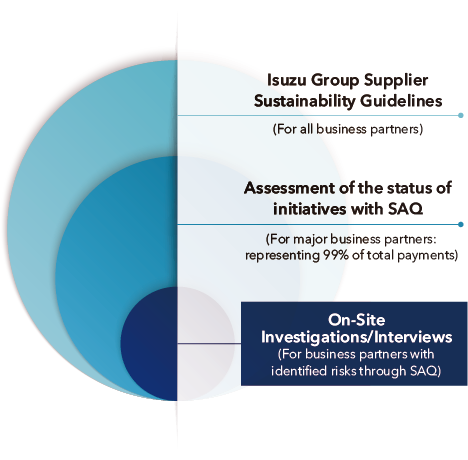
The Isuzu Group expects its business partners to meet standards related to social, ethical, environmental, and corporate responsibility. The Isuzu Group Supplier Sustainability Guidelines (hereinafter referred to as "the Guidelines") reference the Isuzu Group Human Rights Policy, the Isuzu Group Responsible Mineral Sourcing Policy, and other policies of the Isuzu Group, as well as internationally recognized norms and frameworks. If a business partner fails to fulfill its social responsibilities, this not only damages the image of Isuzu as the company doing business with them but also significantly affects production activities, causing considerable inconvenience to customers using Isuzu products. To avoid such risks, we ask our business partners to conduct their activities in line with the Guidelines. The Guidelines set out the practices to be implemented in areas such as human rights, the environment, and compliance. Starting in 2025, we expanded their scope to cover the value chain, with the aim of sharing sustainability values and promoting related initiatives across the entire value chain. We ask our business partners to make use of the Guidelines and to cooperate with Isuzu, through our business relationship, in working toward the realization of a sustainable society. We ask our business partners to sign a letter of consent confirming that they endorse the Isuzu Group's approach and will comply with the requirements of the Guidelines for all products and services supplied to Isuzu. By fiscal 2026, we had received signatures from business partners accounting for approximately 99% of our annual domestic purchasing value. We also request that new business partners conduct their activities in line with the Guidelines.
Management Structure
Isuzu holds a Purchasing Division Quality Meeting once a month to report on and discuss topics such as the quality of the previous month's purchased parts, the results of audits of new business partners, and the results of internal audits and external assessments related to ISO and IATF. The Purchasing Division also holds a Quality and Compliance Promotion Meeting and an Environmental Meeting once a month, and information from these committees is passed on to all departments within the Purchasing Division. The Purchasing Division's policy on activities related to compliance and the environment is determined at these meetings. In addition to these efforts, we have established the following framework to promote understanding of compliance and sustainability, as well as to receive consultations and reports from business partners and provide the necessary response and remedy.
Implementation of Departmental Education
New employees and other employees newly assigned to the Purchasing Division receive introductory training on compliance and sustainability. All division members are provided with seminars on the Act on Preventing Delay in Payment to Small and Medium-Sized Entrusted Business Operators in Relation to Manufacturing Consignment and the Guidelines for Appropriate Trade in the Automobile Industry as appropriate.
Business Partner Consultaon Desk
We maintain a Business Partner Consultation Desk within our Enterprise Risk Management Dept. as an impartial point of contact that accepts consultations from business partners regarding compliance issues. Consultations received through this desk are handled appropriately, with strict confidentiality maintained and with a rule that those who seek consultation will not be treated unfavorably for having done so.
Isuzu's Grievance Handling Mechanism Through a Third-Party Platform
Isuzu has established a remedy mechanism to receive consultations and reports related to human rights. Through the Grievance Form provided by the Japan Center for Engagement and Remedy on Business and Human Rights (JaCER), we accept consultations and reports on human rights matters from our stakeholders, including business partners. We ensure thorough confidentiality for consultations and reports received through this mechanism, and have established a policy that those who make a report will not be treated unfavorably for having done so, ensuring an appropriate response.
Initiatives
Isuzu Supply Chain
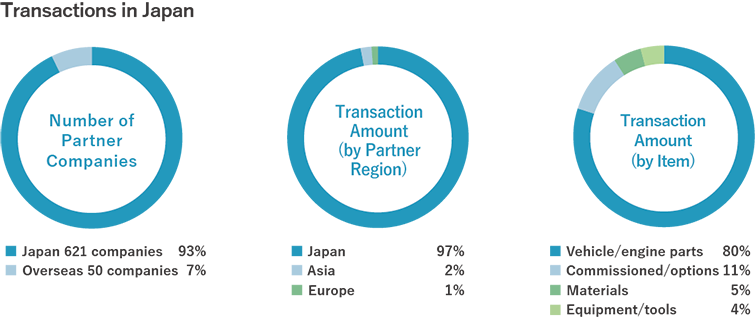
Isuzu chooses its business partners according to a fair and equitable selection process regardless of whether they are based in Japan or overseas. Starting in 2023, we have incorporated sustainability assessments into our business partner selection process. We are engaged in purchasing activities aimed at mutual prosperity with our business partners and are implementing similar initiatives at our global procurement bases to strengthen Isuzu's competitiveness. Isuzu in Japan has a total of 671 domestic and overseas business partners. About 90% of these partners are based in Japan. In terms of transaction amount, the procurement of vehicle and engine parts makes up about 80% of the total.
Regional Development and Job Creation
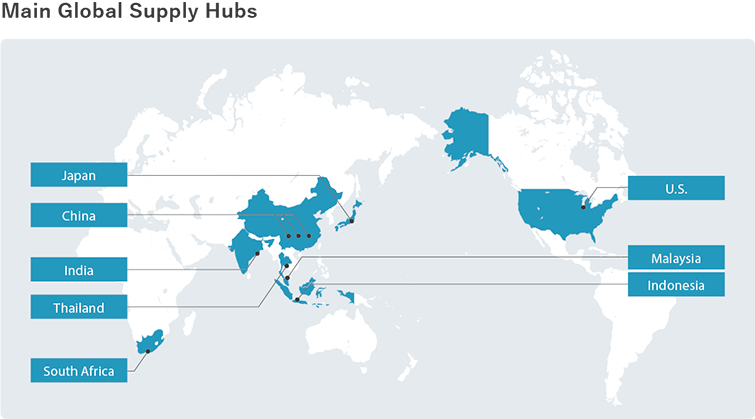
In the countries and regions where it operates, Isuzu promotes the adoption of local parts in order to make use of and develop the local automotive industry and to contribute to local employment.
Communication with Business Partners
Isuzu places great importance on careful and courteous communication with its business partners through briefings and meetings. Through two-way communication with our business partners based on mutual trust, we understand the various activities of our business partners and offer support by inquiring if they have any concerns or difficulties. To keep expanding the global reach of our communications, we are also promoting the use of online tools. At the briefings, we also present Sustainability Awards to business partners that demonstrate outstanding commitment to sustainability, in addition to awards such as those for on-time delivery and quality excellence. We are confident that this kind of communication will contribute to strengthening the supply chain.
Main Opportunities for Communication with Business Partners
- New Year's business leaders' forums
- Procurement policy briefings
- Production briefings
- Supply chain issues briefings
- Quality policy briefings
- Isuzu Kyowakai*
- *Isuzu Kyowakai: A cooperative association comprising Isuzu's business partners
Evaluation of Business Partners' Initiatives Based on the Sustainability Guidelines
Isuzu regularly reviews and evaluates the status of its business partners' sustainability initiatives. Since 2023, business partners that supply us with raw materials and parts have been asked to complete a Self-Assessment Questionnaire (SAQ) on a three-year cycle. The SAQ consists of questions in line with the Isuzu Group Sustainability Guidelines. As of fiscal 2026, we have received responses from 407 major business partners (representing approximately 99% of our annual domestic purchasing value). We have found that two business partners currently present sustainability risks. Where risks have been identified, we conduct on-site or remote interviews and ask the business partner concerned to work on improvements. At our Group companies, we have communicated our approach to sustainability and have begun conducting SAQs and on-site surveys at major overseas locations.
Approach to Surveying the Status of Sustainability Initiatives
Monitoring the Efforts of Our Business Partners
Quality
To monitor the delivery quality and market quality of our business partners, we calculate a monthly evaluation score based on factors such as the number of defect occurrences, the number of defective units, and the severity of defects. Business partners whose delivery quality evaluation scores and defect counts do not meet a set standard are classified as companies subject to management. Business partners whose scores meet the standard, but whose defect counts exceed a set level and whose delivery quality therefore needs improvement, are classified as companies subject to observation. We work to improve delivery quality through measures such as holding monthly quality meetings. As a result of these efforts, in fiscal 2026 approximately 90% of our business partners met the standard for the delivery quality evaluation score. A small number of business partners fell within the definitions of companies subject to management or observation. We joined these business partners in their improvement activities and encouraged them to strive for better quality. In addition, we conduct an on-site audit of certain business partners when they undergo a triennial assessment for the renewal of a direct supply contract, in order to confirm how their quality management systems are operating. For new business partners, we conduct an on-site audit before starting a business relationship and evaluate the effectiveness of their quality management systems to confirm whether they meet our requirements for doing business with us.
BCP
From the perspective of business continuity, there are risks on the production side, such as changes to production plans and operating adjustments caused by shortages in parts supply. These risks may include sudden supply disruptions due to natural disasters, long-term supply reductions due to infectious diseases, and recent geopolitical risks. In each case, numerous challenges need to be addressed from both a short-term and a medium- to long-term perspective. We are continuously promoting the establishment of a BCP/BCM framework and are working on the visualization of our supply chain as a key issue. We have established a system that uses various tools to quickly assess the damage sustained by our business partners and the impact on deliveries in the event of a natural disaster or other incident, enabling us to identify the impact on the supply chain at an early stage. Based on the information gathered, we work to smoothly grasp the scope of impact and share information with relevant departments, accelerating our initial response toward ensuring business continuity. We keep the information registered in our systems up to date and continue working to improve its accuracy. In addition, in fiscal 2026, as a company-wide initiative, we conducted training on internal response procedures in the event of an earthquake. Through these activities, we aim to identify vulnerabilities within the supply chain, pursue strategic inventory management, reduce production lead times, and address geopolitical risks that are becoming more apparent. At the same time, we are establishing a system that accelerates initial responses during disasters, working in cooperation with our business partners to achieve early recovery and minimize the impact on Isuzu's business.
Environment
Isuzu asks its business partners to report on their activities to promote environmental management systems through the Environmental Management Self-Evaluation Report. For fiscal 2026, we received responses to the Report from 360 business partners. The response rate was approximately 99%, and the average score surpassed the previous year's, setting a new record high. In addition to the growing adoption of environmental activities, we believe that supporting business partners' understanding of environmental issues and helping them improve their initiatives through seminars and briefing sessions contributed to an overall improvement in the level of activity. Business partners that are relatively proactive in their environmental activities showed an increase in responses describing specific plans and implementation details for the use of renewable energy. In addition, the number of responses regarding activities that reduce CO2 emissions, such as reducing the number of shipments and promoting a modal shift, has also increased in the wake of Japan's 2024 logistics problem, the driver shortage arising from the 2024 cap on overtime hours, confirming that awareness of environmental activities among our business partners has risen further. We have also used the CDP Supply Chain Program since fiscal 2023 to track our business partners' efforts related to climate change and their GHG emissions. In the current fiscal year, 189 of the business partners we asked to respond, representing approximately 90% of our annual purchasing value, provided responses.
Main voluntary environmental assessment items
- Environmental management systems
- Notification of environmental personnel
- Compliance with environment-related laws and regulations
- Promotion of energy-saving activities
- Reduction of water consumption
- Reduction and appropriate treatment of waste
- Reduction of emissions of regulated chemical substances
- Submission of the Environmental Management Self-Evaluation Report
- Managing environmentally hazardous substances
- Reduction of CO2 emissions and packaging/shipping materials in logistics
Human Rights
Isuzu regards respect for human rights throughout the supply chain as an important responsibility and is committed to fair and sustainable procurement. In particular, we are working on issues related to foreign workers, such as foreign technical intern trainees, as one of our significant human rights themes.
Cybersecurity
To confirm and improve the company-wide cybersecurity measures of our business partners, we ask them to review the cybersecurity guidelines of the Japan Automobile Manufacturers Association (JAMA) and the Japan Auto Parts Industries Association (JAPIA) and to conduct a self-check using the Automobile Industry Security Checklist. So that our business partners continue to advance company-wide cybersecurity measures, we will regularly confirm their progress through the checklist and provide support from Isuzu as needed. Moreover, as part of our efforts to comply with vehicle product cybersecurity requirements under UN Regulation No. 155 (UN-R155) and domestic regulations (the Safety Regulations under the Road Transport Vehicle Act), we have been confirming the establishment and operational status of cybersecurity management systems at business partners handling relevant products. By fiscal 2026, we had carried out these confirmations with a cumulative total of 64 business partners, and we will continue our efforts to maintain regulatory compliance going forward.
Responsible Mineral and Raw Material Sourcing
Isuzu has been conducting surveys of its business partners' sustainability initiatives, including efforts regarding responsible mineral sourcing and human rights. Isuzu considers the use of conflict minerals to be a serious problem, as these minerals cause human rights infringements, environmental destruction, and illegal mining in conflict zones, and are used to finance armed groups. Through the Isuzu Group Supplier Sustainability Guidelines, we therefore ask our business partners to trace their supply chains upstream and confirm that their supply chains are not involved in conflict. In addition, we have conducted surveys on the use of conflict minerals in our business partners' supply chains and the status of their initiatives for responsible mineral sourcing, using the Conflict Minerals Reporting Template (CMRT) and the Extended Minerals Reporting Template (EMRT), the standardized formats provided by the Responsible Minerals Initiative (RMI)*, starting in fiscal 2023. In fiscal 2024, we established the "Isuzu Group Responsible Mineral Sourcing Policy," which was revised in fiscal 2026 and renamed the "Isuzu Group Responsible Mineral and Raw Material Sourcing Policy."
This policy has been approved by the Sustainability Committee and signed by the President and Representative Director.
- *RMI: Responsible Minerals Initiative, an organization based in the United States that addresses conflict minerals issues
Holding of Various Seminars
Environmental Activity Seminars
In reviewing the responses to the Environmental Management Self-Evaluation Report submitted by business partners in fiscal 2025, we found that response levels related to water resource risk were comparatively low among the survey items. In light of this, in fiscal 2026 we held an environmental seminar led by the Water Education Institute. The seminar was attended by 211 companies and deepened their understanding of how water resource risks are viewed in the automotive industry. Also in fiscal 2026, at our supply chain issues briefings, we explained to business partners our activity plans for environmental initiatives, trends in chemical substance regulations, and Isuzu's policies. The briefings were held twice during the year, with approximately 330 companies participating in each session.
Decarbonization and GHG Calculation Seminar
To support our business partners' decarbonization efforts, in fiscal 2026 we held a seminar titled "Decarbonization Trends in the Automotive Industry and the Basics and Practice of GHG Calculation." In anticipation of asking business partners, starting in fiscal 2027, to improve the accuracy of the GHG emissions data needed for Isuzu's Scope 3, Category 1 (Purchased Goods and Services) calculations, we shared basic knowledge of and approaches to emissions calculation as groundwork for this effort. By first making emissions visible and helping business partners identify the sources to be reduced, we aim to connect these efforts to future reduction activities.